Thursday, 9 August 2012

Hong Kong Barbecued Meats


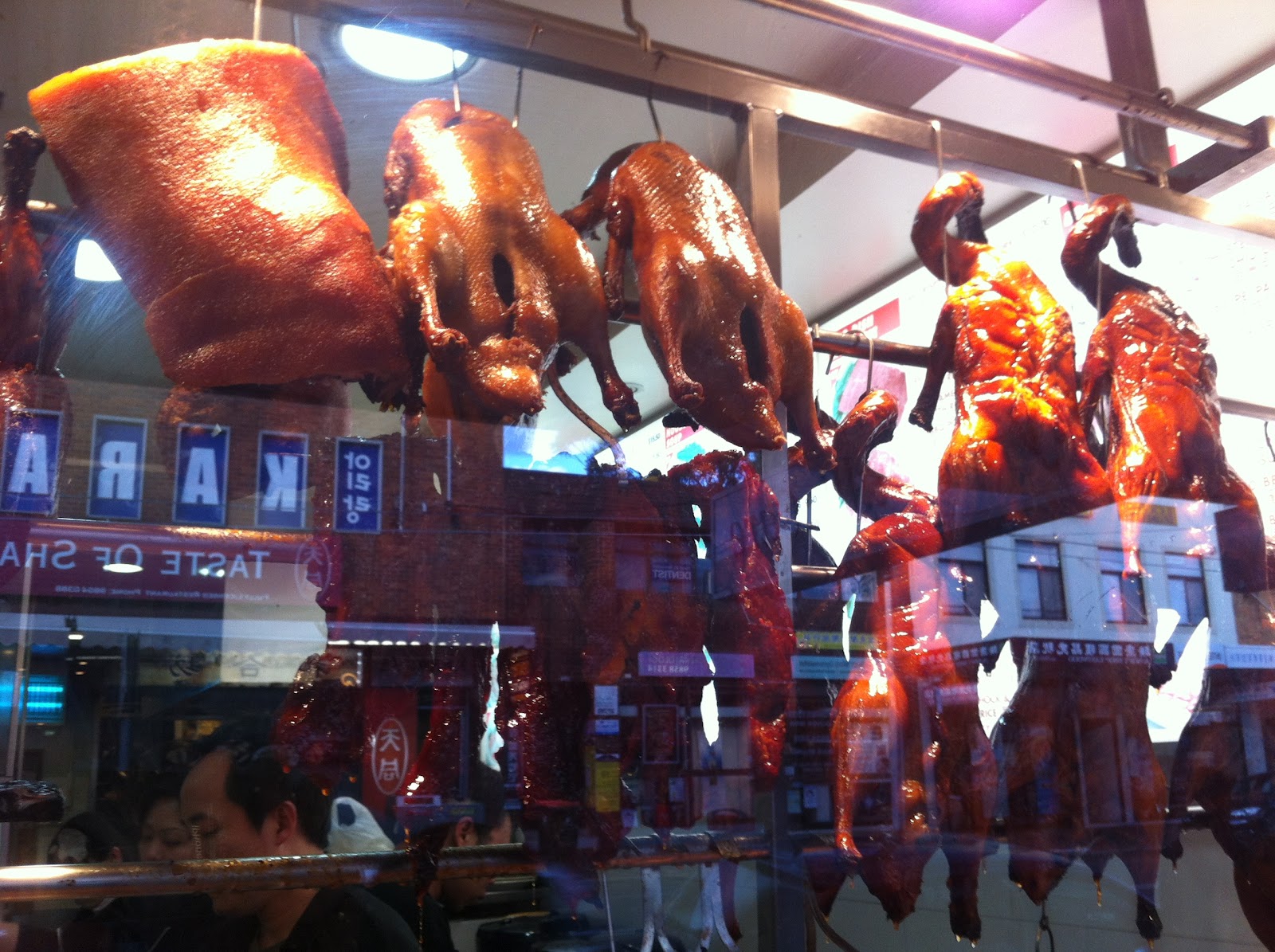
Eastwood, Chatswood, Ultimo, Hurstville in the greater Sydney area.  Doncaster, Richmond, Glen Waverley, Little Bourke Street in Melbourne.  Frisco, Dallas, New York or Chicago in the USA. Vancouver or Toronto in Canada. Soho in London or Chinatown in Amsterdam. Scenes replicated in South-east Asia and Auckland's Dominion Road.  The first wave of emigration out of China was mainly form the southern Chinese provinces, where roasted, barbecued and charbroiled meats were essentially part of the menu and have matured to an art. Glistening, dripping and crunchy. They do look oily.  They can be soy sauced chicken, roast pork, goose or duck, always served whole, replete with neck, claws, buttocks and beaks.  May be it has to do with the Chinese penchant for wholesomeness and intactness.  People line up to buy them whole or cut up in more palatable bite size pieces.  Do note that Chinese styled stuffed sausages and marinated spare ribs are also available in such restaurants.  Above photograph, from left to right: roast pork (siew yoke in Cantonese); whole soy sauced chicken; and whole roast duck.


Seafood grilled and served (picture above), which are often less oily than sheer meats.


As the meats are consumed with steamed white rice (and Lebanese cucumber slices or tomato cuts), it is necessary to also prepare braising sauces to enhance the flavours of such barbecued servings.  Such sauces utilise a combination of light and dark soy sauces, added with touches and dashes of pepper, rock sugar, Shaoxing wine and Chinese rose wine.  It is preferable not to microwave such meats; instead it is better to heat them in the oven or use leftovers as additions to a fresh stir-fry.


Another variation is the compressed, dried and cured duck as shown above.  Originating from winter conditions, it provides a completely different sensation from the barbecued versions.  I am reminded of smoked hams.

Wednesday, 8 August 2012

Harris Park, Sydney - Little India

Parramatta in New South Wales was settled by the British within a few months of landing at Sydney Cove.  Today, in an adjoining suburb, Harris Park is host to a multicultural group that has a third originating from the Indian sub-continent. Punjabi, Gujarati and Hindi are the predominant languages spoken, together with mainstream English.  Interesting enough, the average age of residents is only 30.   I have heard much from mates and in the media about Harris Park, so one boring weekend I did not resist when I had an opportunity to have lunch there. On approach, Harris Park may seem to be another ordinary western Sydney suburb, but on closer examination, I was impressed by the number of restaurants, the preserved architecture and design of dwellings and how life seemingly is centred around one junction - where Wigram and Marion Streets meet.  I can recall Dandenong in Victoria, north-west of Melbourne, with this similar hub of Indian-born migrants, with so many choices in curries, spicy condiments and more.
I also recall the hill station of Simla, with its British Raj inspired designs in buildings, and on my day of visit to Harris Park, it was a nippy Sunday afternoon chill.  The frangipanis had lost their leaves and were expectedly bare-branched, but this added more character to the place.  Lunch was held at the Chutney, with a buffet of two meat curries, basmati rice, naan bread and three vegetarian curries (including lentils and tofu).  The Chutney had many Indian families enjoying themselves that afternoon.
Chutney Indian Restauarant on Urbanspoon


I must confess I had harboured thoughts of finding South Indian cuisine in Harris Park, but the commercial outlets still offered food, especially desserts, of the northern variety. Yes, there is the occasional appearance of Kerala fish curry and Tamil vegetarian curry on some menus, but what is more impressive is the availability of a diverse range of Indian sweet concoctions, anything from Kaju Burfi to Gulab Jamun and Pedas.  Correct me if I am wrong, but the image captured above suggests to me of the Besan Ladoo (besan being roasted gram flour).  The unique ice cream of Kulfi was also spotted.


In a neighbourhood where reformed ex-convict James Ruse was granted land to settle, Harris Park now is  a microcosm of the cultures found usually in south-western Asia.  Our Lady of Lebanon Maronite Church exemplifies the presence of historical manifestations from relatively recent migrants to this part of the world.  I also found a unique and petite Indian craft shop (photo above, to the right)with a patient looking man inside working attentively on his passion.  A major Hindu temple is  accessible at nearby Wentworthville.

The inevitable Indian mega pop star poster (above) can be a source of comfort, familiarity and joy to recent migrants.  Below, at the Taj Indian Sweets along Wigram Street, is what seems to be doughnut-like bites with garnishings of pistachio bits - yummy!


Taj Indian Sweets on Urbanspoon


The sari shop (above ) can be the atypical illustration of an ethnic and unique cultural practice, but what captivated me was the front of the Ginger Indian Restaurant (image below), which seems to blend harmoniously elements of Australian cottage and country life with the lure of spices.

Wednesday, 1 August 2012

The Rocks, Sydney - Vignettes


Hoppers Pancake as Snacks - The Apong


It is a snack I am familiar with from childhood days, a thin crusted light weight pancake with flaky edges, that nevertheless melts in the mouth and provides a crispy bite.  The dough is mainly made from rice flour, the final product involves the delicate skill of the maker and the pancake can be accompanied by spicy garnishings, or eaten plain. Also referred to as apong in Sri Lanka,  South Asia and South-east Asia, it can be a backpacker's staple for breakfast.  The quality of the apong is not just in the taste, plain looking as it can be, but also in the thinness of the skin.  The apam on the other hand is made from sourdough rice.  Quick to make, the apong or the apam is also best eaten fresh.


The batter is made from coconut milk, yeast, rice flour and even fermented coconut toddy. Small rounded pans are utilised to obtain the final bowl-like shape of each apong. When an egg is poached sitting inside each apong, it must be cooked and served runny, with a dash of salt and freshly ground black pepper.  Servings of meat curry, sambal condiments and mashed pumpkin often accompany the hoppers.  The small size of the cooking utensils ensure sufficient heat within a short period of time to come up with the desired thinness of the skins. Pictures here were taken at the Roselyn Community Centre in Carlingford, north west of Sydney, NSW.  Some such hoppers are made otherwise with palm sugar and coconut.  String shaped white coloured hoppers, or putu mayam, are popular in Malaysia as street food.


Torview on its website offers  the following savoury recipe to make hoppers.
Hoppers
2 cups rice flour
1 coconut water
2 tbsp coconut milk powder (optional or put 1/4 cup coconut milk or regular milk)
water
1 tsp yeast (can replace with 1 slice of bread during warm weather)
1 tbsp sugar (if using yeast)
1 tsp salt
1 egg
jaggery (or unrefined cane sugar)  for sweet hoppers
Mix the yeast with a tbsp of warm water and sugar. Add the yeast to all the ingredients and make a thick pourable batter using the blender, if coconut water is not enough add water or coconut milk or regular milk.
Leave the batter to ferment for at least 6 hours or more.
Heat the hopper pan to medium high heat, when it is hot grease the pan with some oil.
Put a ladle full of batter, about 2 tbsp batter and quickly turn the pan in a circular motion to coat the pan. Cook covered.
The outside of the hopper will be crispy and the centre is soft. Leave the pan covered for about 2 minutes when the hopper is cooked it will come out easily.
Pick up one side of the hopper and slide it out of the pan. Make sure it doesn't get burned in the sides faster than getting cooked in the centre, lower the heat if needed.
Serve hot.

Saturday, 28 July 2012

Whatever and However

I recall from Dickens, A Tale of Two Cities, "it was the best of times, it was the worst of times."

Remaining loyal does not pay. That is, when dealing with certain business providers in our everyday routine lives.  When they want you, they woo you to the ends of the Earth. Once they have you, they eventually take you for granted.  Is this what we want in our society?  I am amazed at this attitude of not maintaining customer relationships. In my twenty years dealing with Australian providers,  I seriously am convinced of two things:

1. When they run shouting advertisements, out of the internet, print or telly, on their side, things are actually happening exactly to what they are desperately trying to tell us otherwise - when the catch cry is more captivating, be careful and be very afraid;

2. Like false love and friendships, such businesses court you only in the beginning. After that, I feel like an abandoned parent, of whatever gender, holding the infant (s) in my arms.

Pessimists amongst some I know further articulate that:

3.  Those whose role is to help are of no assistance at all.

4.  These businesses interact with customers without revealing their full agenda - and their front line staff dealing with customers are caught in a real conundrum.

5.  Despite with so much more means of communication to utilise, many more customers feel left high and dry - and not communicated with.  Communication happens most probably because they want to sell you more and milk your farm.

6.   Some can pull wool over our eyes for years.

The optimist in me discusses with my family and mates to:

a.  Always question and ask - assume they do not tell us everything!

b.  Realise it is imperative to do our own research and information search.

c.  Acknowledge that things are not what they appear to be - monitor, check and reconfirm.

d.  Often get a second opinion - and ask why not?

e.  Make the effort to match and compare - review at least annually.

f.   Just enjoy the play with such parties - in the end, it is just a game.

g.  Learn to say "No" ,  "Why Do You Ask" and "I Am Not Interested" more often

h.   Know that there are cosmic forces in the Universe - what goes around comes around (Thank you, Justin Timberlake)


To Go The Distance

Friends and relatives back in Asia do remind me of their relative convenience when accessing food they want at any time. It is often a maxi...