Congee - the word, all at once, brings up visions of fast food, socio-economic battlers, quick but piping hot breakfasts and warmth on cool weather nights. It is an efficient creation, for hard-earned rice is boiled until it amplifies to a more voluminous mix that is soft and gentle on the palates of the very young and elderly. Ubiquitous in East Asia, but surprisingly not at all in the Indian sub-continent, the history of the congee speaks of thrift, patience, sparing conservatism and caution. The congee is a dish that also calls up creativity and economy in use of scarce ingredients - be they bits of green shallot rings, ground pepper, slivers of tender chicken or thinly cut ginger. Yet, at the same time, the congee is also food that emphasises on freshness, quality and aroma. These days the congee feels right at home whether being served at
yum cha sessions, food courts or in midnight cafes. Above photo shows a set of congee-filled bowls ready for consumption, together with a lemon grass leaf infused herbal drink, light soy sauce and vinegar pickled green chili cuts.
The
sar hor fun - or stir fried wide rice noodles bathed in a stock gravy and laden with fresh choy sum vegetables, fish cake squares, calamari, barbecued
char siew, deshelled prawns and juicy pork cuts. Cantonese in origin, the success of delivery and outcome for this dish depends on two critical factors - the heat of the wok used and the oomph of the stock gravy. It can be a messy dish to prepare - and as with most Asian food, require ingredients to be prepared before hand, usually cut into precise bite-sized pieces and with stocks to be made. The choice of ingredients, like the cut of the meat and where it comes from the butchered animal, is significant. Also available with beef and chicken, but rarely with lamb, this dish evokes in me the memory of the
siew yeh, or supper, ala Hong Kong and Guangzhou. East Asians, together with South-East Asians and Mediterranean peoples, love the practice and concept of snacking before bedtime, and in Western countries, you can also see the hubs of eating, drinking and socialising beyond the midnight hour in many ethnic enclaves. This dish, in my mind, is fondly associated with my Dad driving my brothers and me out for a treat after normally curfew hours (sleeping time!) to a roadside stall to wait for freshly cooked servings, often packed with newspaper cover and banana leaf wrapping.

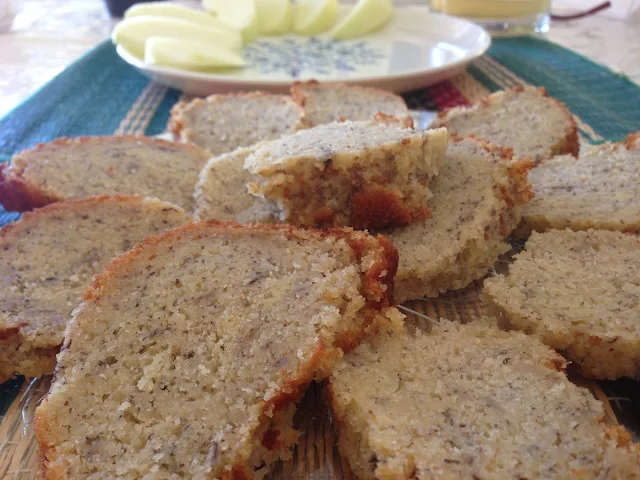
Banana cake slices (picture below) in the foreground , with slices of Star apples in the background. I find that such cakes are made with over ripe and aromatic bananas in Asia, a legacy of colonialism and East-West fusion from the 19th and 20th centuries, whilst in Australia, the bananas used are not so ripe and not so mushy. High tea implies cakes with sugar and spice, but banana cakes are more savoury than sweet. Are they better accompanied by a cup of tea, or by dunking in coffee? The penchant for habitually drinking tea became entrenched in Britain after a Portuguese princess married an English King - and coffee beans were introduced to Europe by the Arabs and Moors. So how did bananas came to be introduced into Western concepts of flour based cakes? It was in another continent - the USA, when the economic Depression drove ingenuity to utilise baking soda, baking powder and bananas to create something which could be sold and for which there was a market, when money was hard to come by. The banana cake recipe was first published in Pilsbury’s Balanced Recipes of 1933. Banana cakes (or for that matter, banana bread, when cooked in a loaf tin) do exude a warm feeling of welcome and warmth when coming home to. Banana cakes also remind me of school fetes and sports functions.


 Posts


